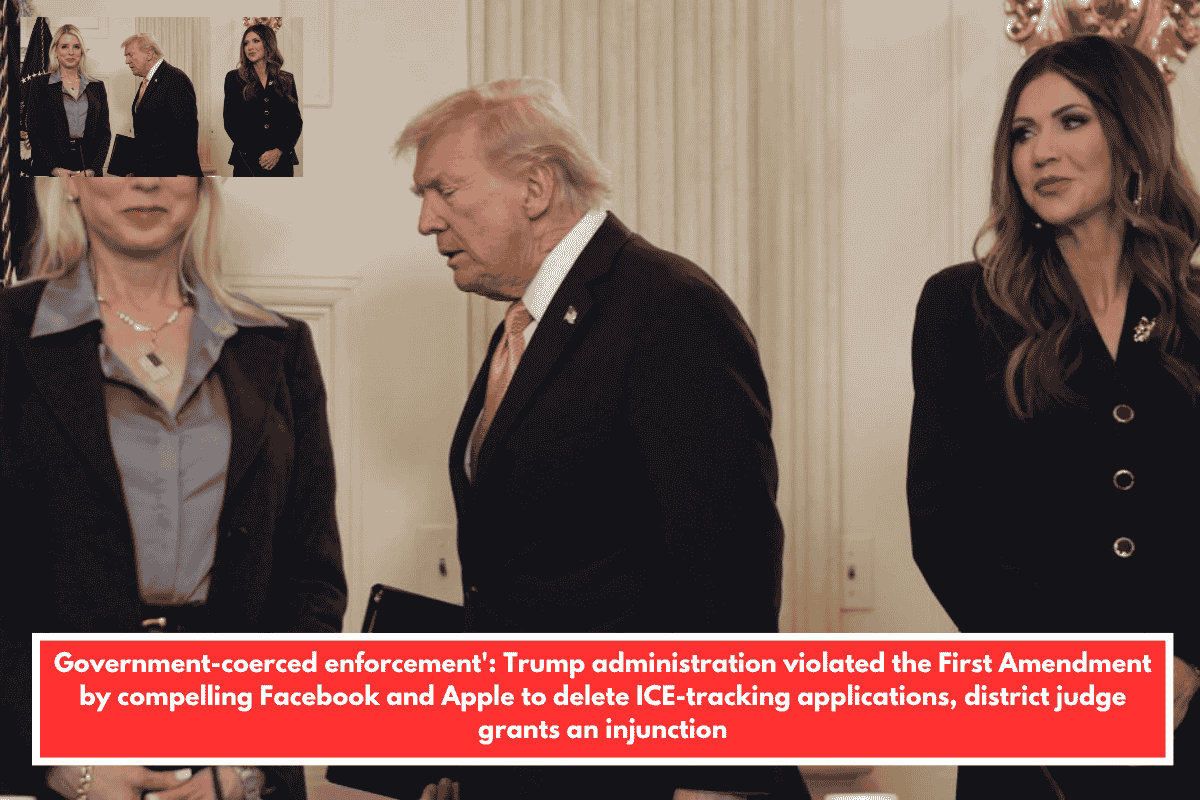
A recent U.S. court ruling has brought attention to free speech rights and the role of the government in influencing tech companies. The case focuses on whether officials crossed a legal line by pressuring platforms to remove content related to immigration enforcement.
What the Court Decided
A federal judge, Jorge Luis Alonso, ruled that actions taken by officials from the Trump administration likely violated the First Amendment.
The court found that government officials pressured major tech companies to remove content critical of U.S. Immigration and Customs Enforcement (ICE).
Because of this, the judge granted a preliminary injunction, meaning the government must stop such actions while the case continues.
What Content Was Removed
Two main platforms were involved:
- Eyes Up (a mobile app)
- Facebook group called “ICE Sightings – Chicagoland”
These platforms allowed users to:
- Share videos of ICE activity
- Post information about immigration enforcement in their area
Both were removed in October 2025 after contact from government officials.
Role of Government Officials
The lawsuit named key officials, including:
- Pam Bondi
- Kristi Noem
According to the court:
- Officials did not simply request removal
- They “coerced” or pressured companies
- Public statements suggested credit for taking down the content
This raised concerns that companies acted out of fear of government action.
Why the Court Found It Unconstitutional
The First Amendment protects free speech from government interference.
The court explained that:
- The government cannot force private companies to censor legal speech
- Even indirect pressure or threats can violate the Constitution
- The content removed did not clearly break platform rules
For example:
- Facebook had removed only a few posts out of thousands
- Apple had already reviewed and approved the app earlier
Despite this, both platforms removed the content soon after government contact.
How the Situation Developed
The issue gained attention after:
- Laura Loomer shared the Facebook group publicly
- She tagged government officials
- Within days, the group was taken down
Officials later posted online claiming credit for the removal.
Impact of the Ruling
The judge stated that the government’s actions had ongoing negative effects:
- The Facebook group remains disabled
- The app is still unavailable
- Users’ ability to share information is restricted
The court believes stopping this pressure will allow companies to make independent decisions.
What Happens Next
The case is not fully over yet.
- The injunction is temporary
- Final terms will be decided soon
- The broader lawsuit will continue
This means the court will still decide the full legal outcome later.
Why This Case Matters
This case raises important questions about:
- Free speech in the digital age
- Government influence over tech platforms
- The balance between public safety and civil rights
It shows that even indirect government pressure can be treated as censorship if it limits lawful expression.