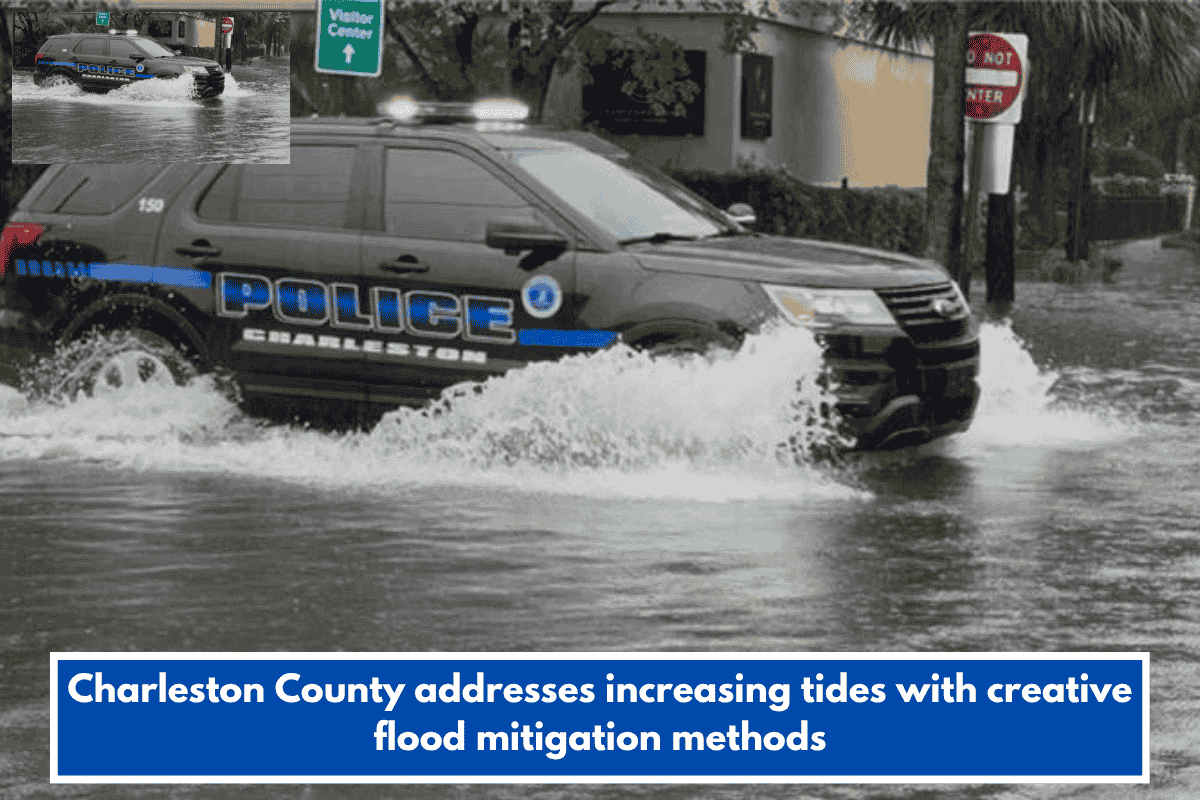
Charleston County, South Carolina — Salt marshes that reach to the horizon, twisting tidal creeks, and barrier islands sculpted by millennia of shifting sands are all characteristic of the Lowcountry. Rising sea levels, greater storms, saltwater intrusion, and rapid growth are putting our home’s durability to the test.
“The county is serious about you know, improving our planet and also increasing our resilience to the hazards that we know we’re facing,” said Molly Caggiano, Charleston County’s Resilience and Sustainability Manager.
A hazard vulnerability assessment was performed over a year ago, and work is currently being done on two of the measures.
“One of them is developing a flood mitigation prioritization matrix, which is just a decision making tool for the county to look at all of the data that we’ve collected about, you know, flood risk exposure and alongside other elements like the social and economic vulnerability, and use all of that information to make decisions about where to locate flood mitigation projects and how to engage the community in that work,” Caggiano told the audience.
Flood mitigation can mean a multitude of things.
“Clearing drainage ditches, but there’s also things like planting more trees and doing what we call nature-based solutions, which are more focused on putting green infrastructure in, or thinking about the natural environment and how our natural landscape can reduce our risk to flooding just by the way that we decide to build or plant,” Caggiano told me.
Other possibilities include creating rain gardens and constructing rain barrels, while planting trees benefits places experiencing high heat.
Brownfields, which include closed laundromats and dilapidated gas stations, are another issue that the county is addressing.
“You remove the chemicals from that site, clean it up,” Caggiano added. “And as part of the strategic planning process, you invite the community to share their ideas for what they want to see on this website. You know, how do you intend to reinvigorate this? And what about your local economic incentives? So, that may be a farmer’s market, an open space, or a public park.”
The county has won two awards under the EPA’s Brownfields program.
At the end of the day, everyone concerned simply wants to transition to a clean energy economy while attaining health, equality, economic, and resilience benefits, which is the goal of the Sustainability Plan, which was approved in summer 2024.
“With Charleston being so diverse geographically with, you know, Edisto Island all the way up to Awendaw, we have the island communities and the rural, there’s a lot of different ways that we can approach resilience and sustainability across the county,” Caggiano told the crowd. “And if we can, if the county can convene and collaborate and talk more together about those initiatives and learn from each other, I think that’ll be what helps advance this work.”