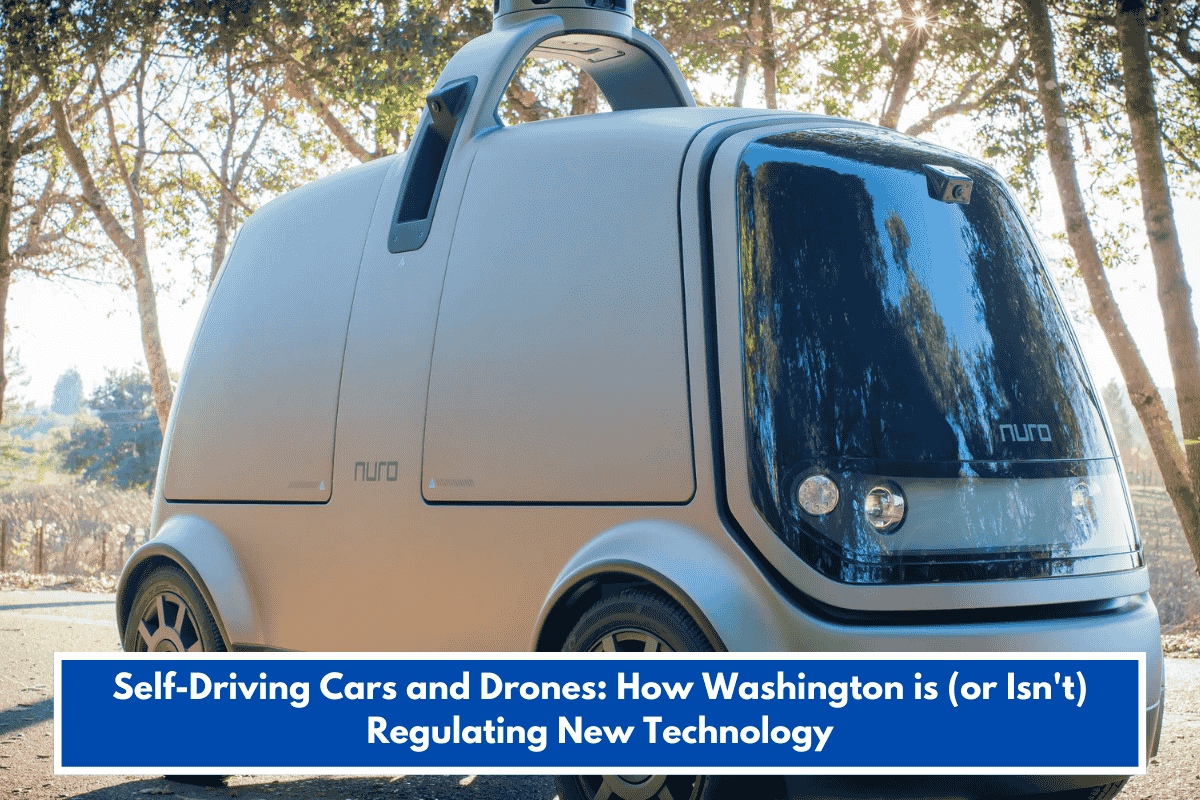
Washington state regulates self-driving cars and drones through targeted frameworks that prioritize testing safety over full commercial deployment, balancing innovation with public protection. While autonomous vehicles operate under a self-certification pilot program, drones face stricter airspace and privacy rules amid ongoing federal-state tensions. These laws reflect cautious progress as of early 2026, with recent bills addressing operator requirements.
Autonomous Vehicle Rules
Chapter 46.92 RCW governs autonomous motor vehicles (level 4 or 5 automation), requiring self-certifying entities to submit contact details, testing locations, VINs, and proof of insurance before public road tests. Entities must report collisions, moving violations, and annual summaries to the Department of Licensing, while notifying local law enforcement in advance. Seattle supplements this with local permits mandating test drivers and first-responder plans, as issued to firms like Zoox and NVIDIA.
Recent Legislative Efforts
Bills like HB 1984 and SB 5042 (2025 session) propose mandating human operators or safety drivers in autonomous vehicles, citing liability and emergency response concerns, though full driverless operation remains limited to testing. No widespread commercial deployment exists, unlike states such as California or Arizona.
Drone Regulations
Washington aligns with FAA rules for drones (under 55 lbs), requiring registration, remote ID broadcasting, and visual line-of-sight operations, with state additions via RCW 14.16 banning flights over critical infrastructure without permits. Privacy laws limit surveillance drones, and local ordinances in cities like Seattle restrict hobbyist flights near events or parks. Commercial ops demand Part 107 certification, emphasizing cybersecurity against hacking risks.