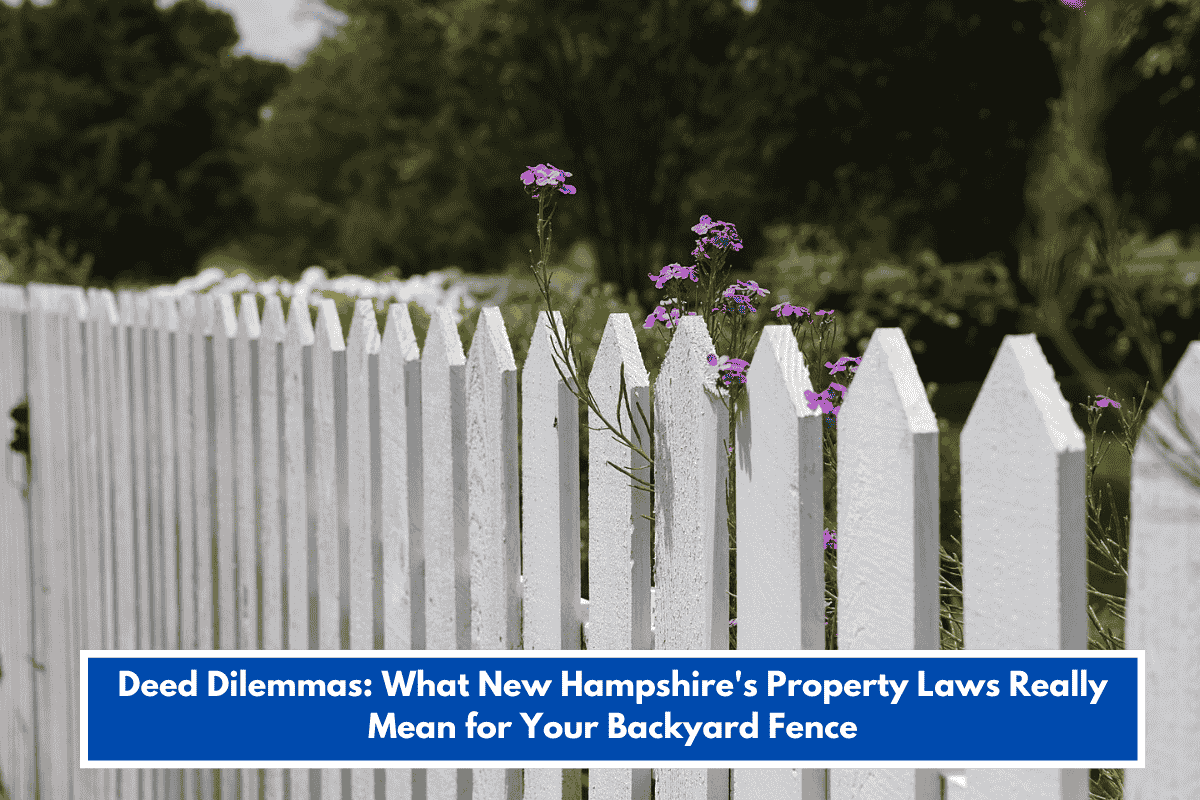
New Hampshire property laws govern backyard fences through deeds defining boundaries, state partition fence statutes, and local zoning, emphasizing shared responsibility for division fences between improved lands while prohibiting spite structures. Disputes often involve verifying property lines via deeds or surveys before fence placement to avoid adverse possession claims after 20 years of hostile use. Local rules vary, so check town ordinances for permits and height limits.
Boundary and Placement Rules
Deeds establish exact property lines; fences can sit on the boundary if neighbors agree, but owners must confirm via survey to prevent encroachment. Partition fences between adjoining improved lands require equal sharing of building and maintenance costs, with fence-viewers resolving disputes by appraising and assigning shares if needed. Place fences inside your line (often 1-2 feet) for maintenance access, avoiding public rights-of-way or easements.
Height and Permit Requirements
Backyard (rear/side yard) fences typically max at 6 feet; front yards limit to 4 feet, with permits needed for over 6 feet, historic districts, or certain towns like Gilford. Spite fences over 5 feet built to annoy neighbors qualify as private nuisances, removable via court if lacking legitimate purpose like privacy or containment. Corner lots restrict visibility-obstructing fences between 2.5-10 feet near intersections.
Common Disputes
Adverse possession allows title transfer if a neighbor openly uses your land (e.g., via misplaced fence) for 20 years continuously and exclusively, strictly construed by courts. Fence-viewers handle insufficiency claims, ordering repairs with double recovery for the compliant party. No broad “good neighbor” cost-sharing beyond partitions; review deeds for restrictive covenants limiting fences.
Resolution Steps
Survey boundaries first, then notify neighbors or apply to fence-viewers for division/appraisal. For disputes, document via photos and written notice; sue for nuisance/trespass if needed, renewing bounds every 5 years on common fields. Consult local planning for zoning compliance to avoid violations.
SOURCES
[1](https://nationalaglawcenter.org/wp-content/uploads/assets/fencelaw/newhampshire.pdf)
[2](https://www.portsmouthnh.gov/planportsmouth/guidelines-fences)
[3](https://www.forestsociety.org/document/adverse-possession-handout.pdf-0)
[4](https://www.gilfordnh.gov/faq/Planning-and-Land-Use-Department-9)
[5](https://www.derrynh.gov/code-enforcement-building/pages/fences)