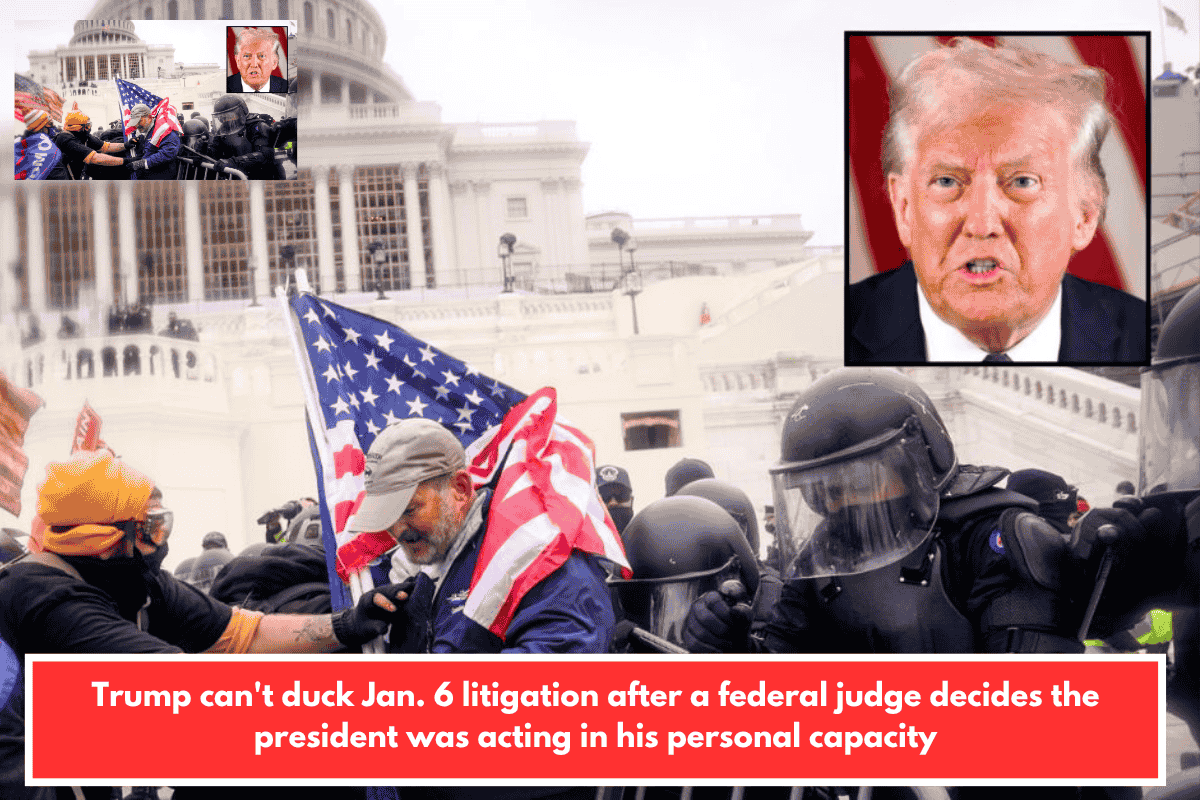
A U.S. federal judge has rejected President Donald Trump’s attempt to shield himself from civil liability for his role in the January 6 Capitol riot, ruling that his actions that day—especially his speech at the Ellipse—are not protected by “official‑acts” presidential immunity. U.S. District Judge Amit Mehta, an appointee of President Barack Obama, held that Trump’s Ellipse speech was political in nature and falls outside the core of his official presidential duties, allowing consolidated civil lawsuits over January 6 to move forward.
Key Points from the Ruling
- Mehta dismissed Trump’s claim that his January 6 conduct was “official” and therefore immune, saying the Ellipse speech “reasonably cannot be understood as falling within the outer perimeter” of presidential duties and is not covered by official‑acts immunity.
- The judge also rejected the current Department of Justice’s attempt to substitute the United States as the defendant in the cases, which would have effectively ended Trump’s personal civil exposure. Mehta instead let the lawsuits against Trump proceed.
- Mehta also turned aside Trump’s bid to revive a First Amendment defense, emphasizing that the context and content of the Ellipse speech plausibly support an inference of incitement, not protected political speech.
Role of Cassidy Hutchinson’s Testimony
Mehta leaned heavily on testimony from Cassidy Hutchinson, a former White House aide to Chief of Staff Mark Meadows, who described Trump’s mood and remarks just before the Ellipse rally. She testified that Trump was angry the crowd was not full and that he ordered Secret Service to remove magnetometers so armed people could enter, saying in effect: “Take the F’ing mags away… Let my people in. They can march to the Capitol from here.”
The judge wrote that this testimony makes it more plausible that Trump knew some supporters were armed and potentially primed for violence, and that his words can reasonably be read as an implicit call for imminent violence or lawlessness rather than protected rhetoric.
Trump’s Georgia Call and “Rapper” Analogy
Mehta also cited Trump’s January 2, 2021, call to Georgia Secretary of State Brad Raffensperger, in which Trump asked him to “find” enough votes to flip the state. The judge characterized those remarks as those of an office‑seeker trying to overturn an election, not an incumbent president acting in an official capacity.
In a separate section, Mehta dismantled Trump’s hypothetical comparing himself to a rapper whose concert “leads to fan violence.” Trump argued that if the rapper’s lyrics and exhortations are protected, so should his own speech. Mehta replied that the analogy breaks down because, unlike the fictional rapper, Trump had spent weeks telling supporters the election was stolen and that they needed to act, and there was evidence that some supporters arrived armed and prepared for confrontation.
What This Means Going Forward
Mehta stressed that his ruling is not a final declaration of immunity for any specific act; Trump can still raise official‑acts immunity as a defense at trial. However, the judge made clear that the burden will lie with Trump and will require a higher standard of proof. For now, the decision is a significant legal setback for Trump in the remaining civil litigation tied to January 6 and reinforces the idea that his conduct on that day is subject to judicial scrutiny, not automatic presidential protection.