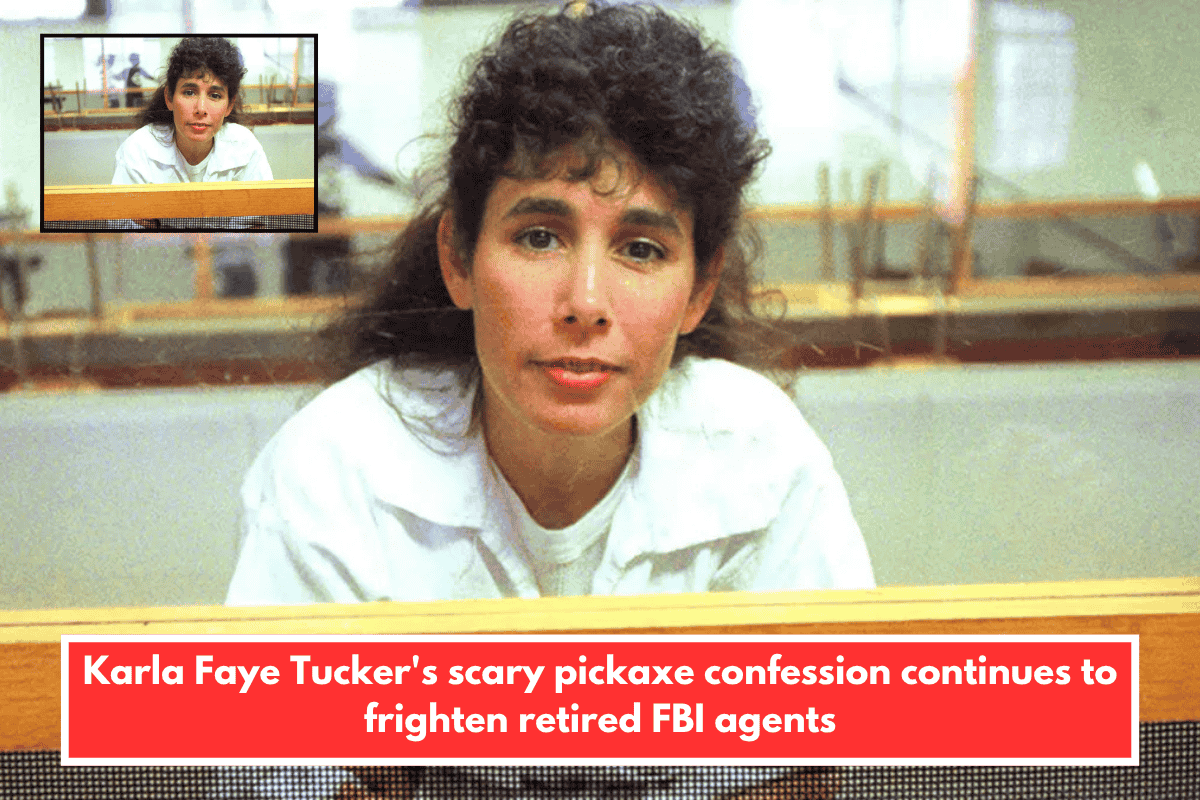
Karla Faye Tucker, the first woman executed in Texas since the Civil War, became a symbol of the complexities surrounding criminal justice, rehabilitation, and the death penalty.
Tucker’s case, particularly her conversion to Christianity while on death row, sparked national debate on whether she deserved clemency after committing heinous crimes in her past.
The Crime and Early Life of Karla Faye Tucker
In 1983, Tucker, alongside her boyfriend Daniel Ryan Garrett, brutally murdered Jerry Lynn Dean and Deborah Thornton with a pickax during a burglary in Houston, Texas.
The couple had intended to steal motorcycle parts, and during the crime, Tucker reportedly experienced sexual arousal while stabbing one of the victims, a detail that later became a focal point of public repulsion.
Tucker’s upbringing played a significant role in shaping her life. According to Candice DeLong, a retired FBI agent and criminal profiler, Tucker’s childhood was filled with neglect and abuse.
Her mother became a sex worker, and Karla, raised in a turbulent environment, was exposed to drugs at an early age. DeLong believes that Tucker’s early exposure to drugs and a chaotic upbringing likely contributed to her violent behavior.
The Conversion and Its Impact
While serving time on death row, Tucker converted to Christianity, a transformation that some argued was genuine, while others questioned its sincerity.
Many of her supporters, including religious figures, advocated for clemency, citing her apparent rehabilitation and newfound faith as evidence that she no longer posed a threat to society.
DeLong, however, remained skeptical of Tucker’s conversion. On her podcast Killer Psyche, DeLong discussed how many prisoners claim to find God in prison, but she questioned whether Tucker’s newfound faith was truly transformative.
“Prison is exactly where she belonged for obvious reasons,” DeLong said, emphasizing that Tucker needed to be contained and monitored.
The Public’s Response and the Death Penalty Debate
Tucker’s case became a point of contention in the national debate over the death penalty. Supporters of her execution argued that she was a dangerous individual who derived sexual pleasure from killing, and they feared that if released, she would return to a life of violence.
Many felt that the brutality of her crime and her disturbing statement about enjoying the act of murder left no room for forgiveness.
On the other hand, Tucker’s conversion and behavior in prison led some to believe she had been rehabilitated. She had become a model inmate, and her supporters argued that the execution of someone who had shown genuine remorse and changed their ways was unjust.
The Execution and Its Aftermath
Tucker was executed by lethal injection in 1998, despite the appeals and efforts for clemency. Her execution marked a controversial moment in the debate over capital punishment, particularly the execution of women. Garrett, her accomplice, died in prison in 1993.
DeLong reflected on Tucker’s case, stating that it was clear Tucker was a product of her environment but that she ultimately posed a threat to society, and the decision to execute her was one that the public supported.
“We want them gone. We want the memory gone. And how do you do that? The ‘Death Chamber,'” DeLong said, expressing the societal need to remove individuals who commit such gruesome acts.
Tucker’s Legacy and the Debate Over Capital Punishment
Karla Faye Tucker’s case remains central to ongoing discussions about the death penalty, rehabilitation, and the possibility of redemption. While her conversion to Christianity in prison offered some a sense of closure, for others, it did not erase the horrors of her crime.
Her execution and the surrounding debates continue to shape the conversation about justice, punishment, and the potential for change within the criminal justice system.