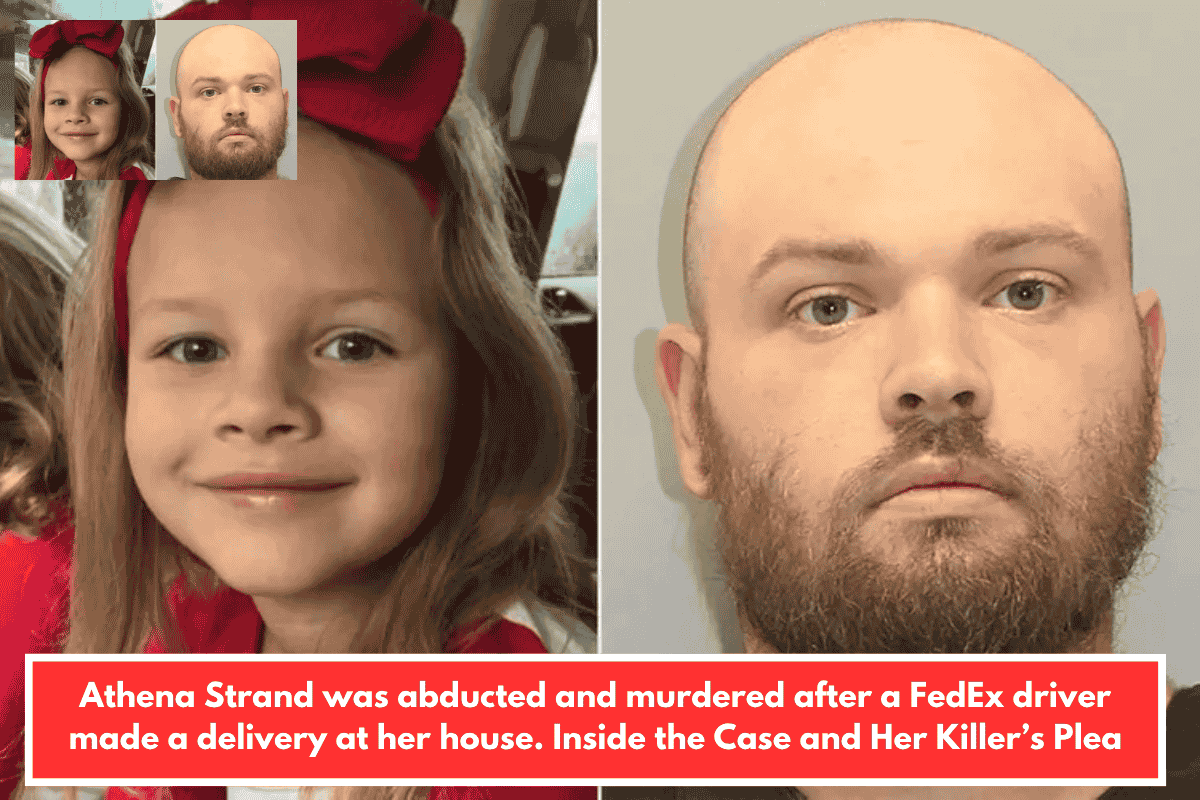
Athena Strand, a 7‑year‑old Texas girl, was kidnapped and murdered in November 2022 by former FedEx delivery driver Tanner Horner, who later pleaded guilty to capital murder and aggravated kidnapping more than three years after her death. Her case shocked the nation and led to a wrongful‑death lawsuit against FedEx, its contractor Topspin, and Horner.
Who Athena Strand was
Athena lived in Wise County, Texas, with her father and stepmother, Elizabeth “Ashley” Strand. She was a bright, typical elementary‑aged girl who was especially excited about the holidays. Her mother, Maitlyn Gandy, had ordered a “You Can Be Anything” Barbie set for her, and the last FedEx truck to arrive at the home that day was the one carrying Athena’s gift.
How Athena disappeared and was found
Athena was reported missing on November 30, 2022, after her stepmother realized she was not in the makeshift bedroom she and her stepsister slept in—a converted storage shed outside the main house, which was undergoing construction.
Days later, authorities found Athena’s body in an area near a river about nine miles from her home. The arrest affidavit says Horner—from the very beginning—told investigators he had helped locate the spot, effectively leading them to her remains.
What Horner told investigators he did
Horner was a contract delivery driver for Topspin, a company that delivered packages for FedEx, and had just delivered Athena’s Christmas package when he saw her in the driveway.
According to the affidavit, he claimed he accidentally hit her while backing up, then put her in the back of his van, panicking about what to do next. He told police she was alive and talking, giving her name, but he feared she would tell her father he had hit her with the truck.
He then said he tried to break her neck, and when that failed, he strangled her with his bare hands in the back of the van. Imagine a 7‑year‑old girl, having just received a toy meant to inspire her big dreams, instead being forced into a confined space in a delivery truck and murdered in a panic‑driven act of violence.
Evidence and the trial
Investigators relied on several key pieces of evidence, including:
- Camera footage from inside the FedEx truck, which showed Athena still awake and on her knees in the back of the van, indicating interaction rather than a purely accidental death.
- The fact that Athena was found naked, with DNA evidence of sexual assault, and with injuries consistent with being strangled.
Initially, Horner was charged with capital murder, aggravated kidnapping, and, in later filings, with three counts of sexual assault of a child, although it has never been publicly confirmed whether Strand was the specific child named in those sexual‑assault counts.
At his February 2023 indictment, he pleaded not guilty, but the case dragged on for years. On April 7, 2026, Horner changed course and pleaded guilty to capital murder and aggravated kidnapping, meaning the case moved straight into the penalty phase, where a jury will decide whether he gets the death penalty or life in prison.
The family’s lawsuit and broader fallout
Shortly after Horner’s arrest in December 2022, Athena’s father and then her mother filed a wrongful‑death lawsuit against Horner, FedEx Ground, and the contractor Topspin, arguing that the companies had a duty to screen drivers properly and that better vetting might have prevented the tragedy.
The lawsuit’s language is emotionally powerful:
“This is about a vibrant young girl who deserves to have her memory live on for the good she brought to the world … a life that was taken senselessly, a child who could have been any of ours. It is about a loss that could have and should have been prevented.”
Athena’s family and supporters, along with the public, have struggled to reconcile the image of a trusted FedEx driver—someone who comes to the door daily in many American homes—with the reality of a man who allegedly used that access to abduct, sexually assault, and kill a 7‑year‑old girl.
Where the case stands now
Today, Tanner Horner sits in Texas custody while a jury weighs his punishment. Prosecutors argue that the only “true” thing Horner told police was that he killed her; everything else was a “web of lies” meant to deflect blame. His defense emphasizes that he has autism and other mental‑health issues, and that his mother allegedly drank during pregnancy and exposed him to heavy lead levels, suggesting he has long‑standing mental challenges.
Regardless of the court’s final decision, the legacy of Athena Strand has become about child safety, the trust we place in everyday delivery workers, and how quickly a simple act—like a Christmas package being delivered—can spiral into a national tragedy.