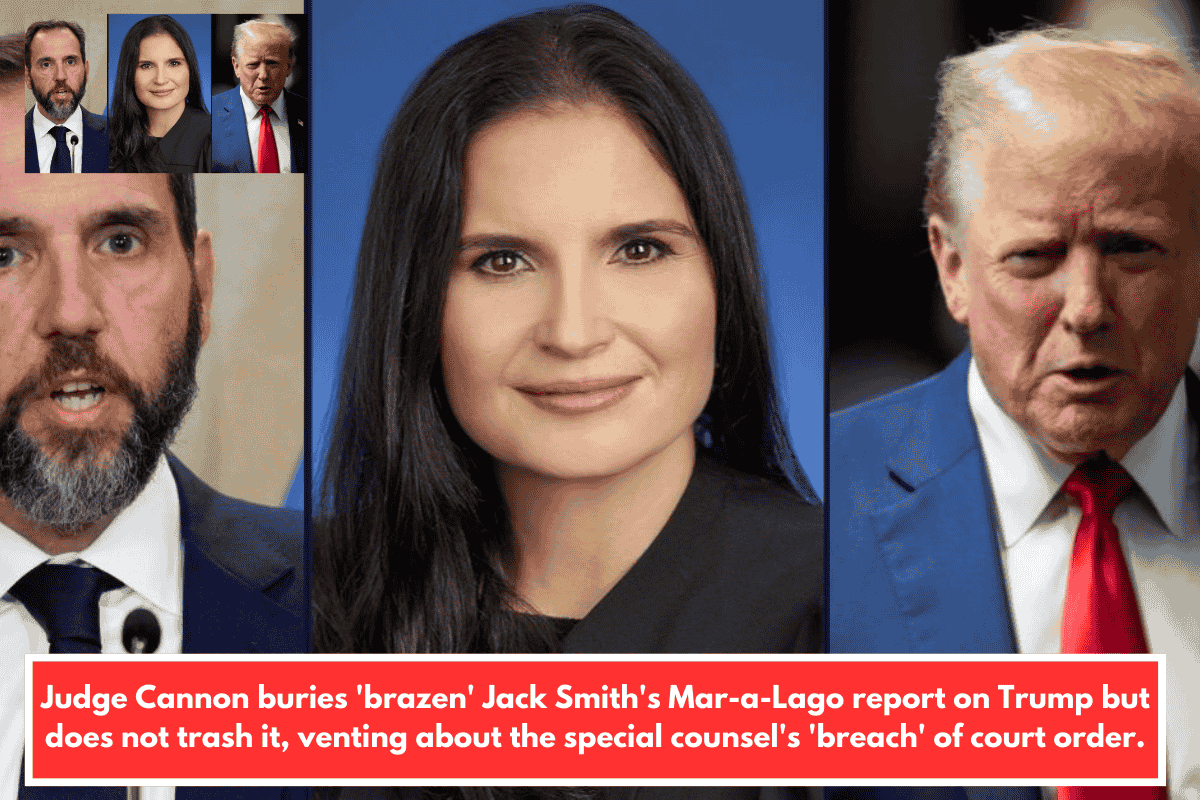
U.S. District Judge Aileen Cannon on Monday permanently barred the Justice Department from releasing Volume II of Special Counsel Jack Smith’s final report on the Mar-a-Lago classified documents investigation outside the Department of Justice. However, she declined to order the destruction of the volume.
The ruling stems from Cannon’s July 2024 dismissal of the Espionage Act prosecution against Donald Trump. In that decision, Cannon concluded that Smith had been unlawfully appointed as special counsel and invalidated all of his actions in the case. On Monday, she extended that reasoning, finding Smith lacked the authority to use case discovery materials to prepare Volume II of the report.
Criticism of Special Counsel’s Actions
In her order, Cannon sharply criticized Smith and his team, describing their preparation and transmission of the report as, at minimum, a concerning breach of the spirit of her dismissal order. She noted that after the case was dismissed, Smith’s team compiled a final report and delivered Volume II to the attorney general during a period of emergency motion practice leading up to the presidential transition.
Cannon wrote that her earlier dismissal made clear that all of Smith’s actions in connection with the prosecution were “ultra vires,” meaning beyond his legal authority. She concluded that the court need not permit what she characterized as a circumvention of her prior ruling.
Arguments from Trump’s Co-Defendants
Attorneys for Trump and his former co-defendants, Waltine Nauta and Carlos de Oliveira, had argued that Volume II was unlawfully prepared and should be invalidated. Trump lawyer Kendra Wharton described it as “ultra vires work product” and urged the court to set aside all of Smith’s subsequent actions, including the report’s creation.
While Cannon agreed to block its release, she rejected arguments from Nauta and de Oliveira that Volume II should be destroyed.
Comparison to Past Special Counsel Reports
Cannon distinguished the situation from previous special counsel reports issued by figures such as John Durham, Robert Mueller, David Weiss and Robert Hur. She noted that prior reports were released either after decisions not to bring charges or following guilty pleas or convictions. In contrast, the charges in this case were contested and did not result in a finding of guilt.
Citing “basic fairness” and the need to prevent “manifest injustice,” Cannon ordered that Attorney General Pam Bondi and her successors are permanently prohibited from releasing, sharing or transmitting Volume II or any of its drafts outside the Justice Department.
Free Speech and Transparency Challenges
The ruling drew criticism from advocacy groups including the Knight First Amendment Institute and American Oversight, both of which argue the public has a right to access at least a redacted version of the report. American Oversight executive director Chioma Chukwu said the organization would use “every tool available” to seek its release, calling the information a matter of extraordinary national importance. Knight Institute executive director Jameel Jaffer similarly asserted that both common law and the First Amendment support disclosure.
Trump attorney Kendra Wharton praised Cannon’s decision, reportedly calling it an example of judicial courage on due process issues.
The decision is likely to face continued legal challenges as advocacy groups pursue appeals seeking public access to the report.