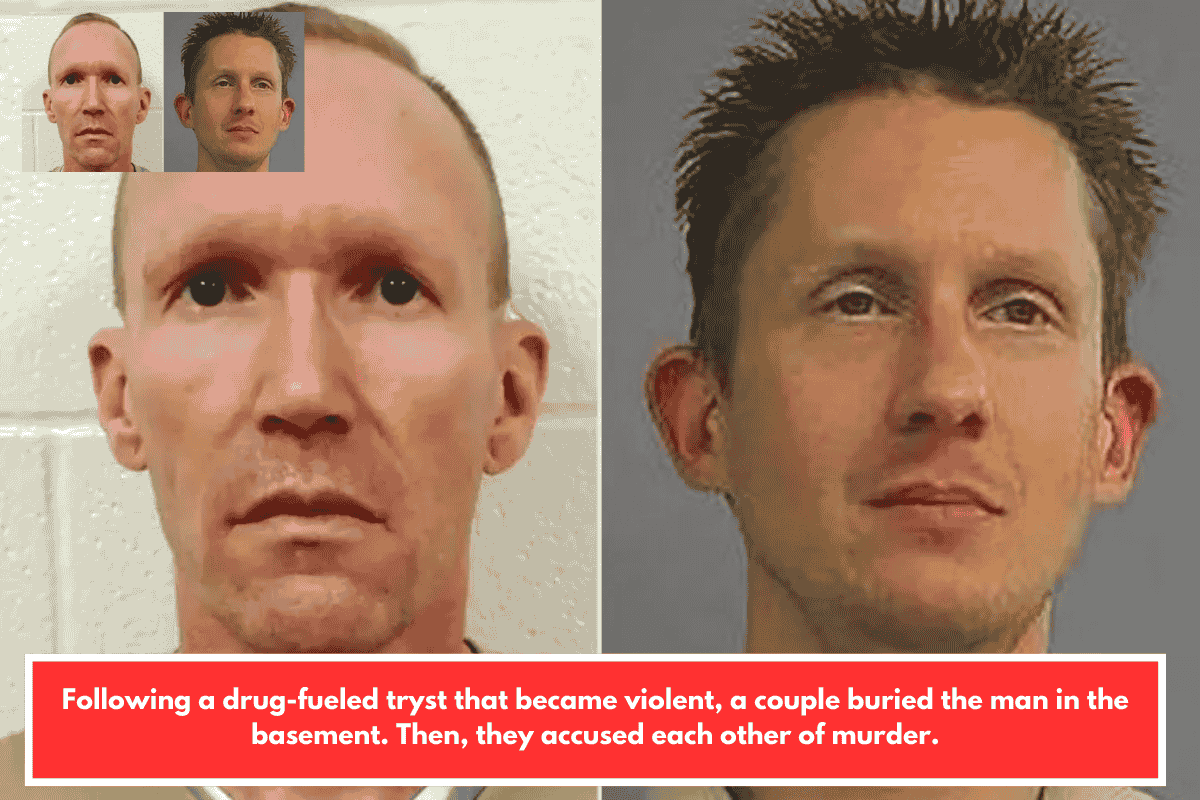
The case began with a 911 call in Kentucky in June 2010, when Jeffrey Mundt reported that his former partner, Joseph Banis, was attempting to break down his bedroom door with a hammer. Audio from the call captured Mundt growing increasingly panicked as loud banging could be heard in the background. Police responded to the home and arrested Banis at the scene.
While being transported to the station, Banis allegedly made a shocking statement to officers, saying there was a dead body buried in the basement of the home. Authorities later discovered the remains of Jamie Carroll, who had been buried there for more than six months. Carroll had suffered six stab wounds and a single gunshot wound to the head. His death was ruled a homicide.
The case is the subject of the two-part HBO documentary Murder in Glitterball City, which chronicles the investigation and subsequent trials using police footage and court records.
Conflicting Stories and Arrests
During interrogations, both Mundt and Banis admitted that Carroll had come to their home for what they described as a drug-fueled encounter on the night of his death and that they had buried his body in the basement. However, each accused the other of committing the murder. Mundt told police that Banis slit Carroll’s throat and then shot him, claiming he helped bury the body out of fear for his own life. Banis, meanwhile, alleged that Mundt, driven by jealousy, stabbed and shot Carroll while he watched.
Both men were charged with first-degree murder, robbery, and tampering with evidence. They were tried separately. Banis’ trial began in February 2013, during which Mundt testified against him, stating that he had remained silent out of fear. A jury ultimately convicted Banis of complicity to murder, robbery, and tampering with evidence, and he was sentenced to life in prison.
Different Outcomes in Court
Three months later, Mundt went to trial. Unlike Banis, he presented a crucial piece of evidence: a videotape in which Banis appeared to confess to killing Carroll while claiming he was holding Mundt hostage at gunpoint in a motel room. The jury acquitted Mundt of murder but convicted him of robbery and tampering with evidence. He was sentenced to three years for robbery and five years for tampering but was released after serving about one year.
Banis remains incarcerated and will be eligible for parole in 2030 as he continues to pursue efforts for a new trial.