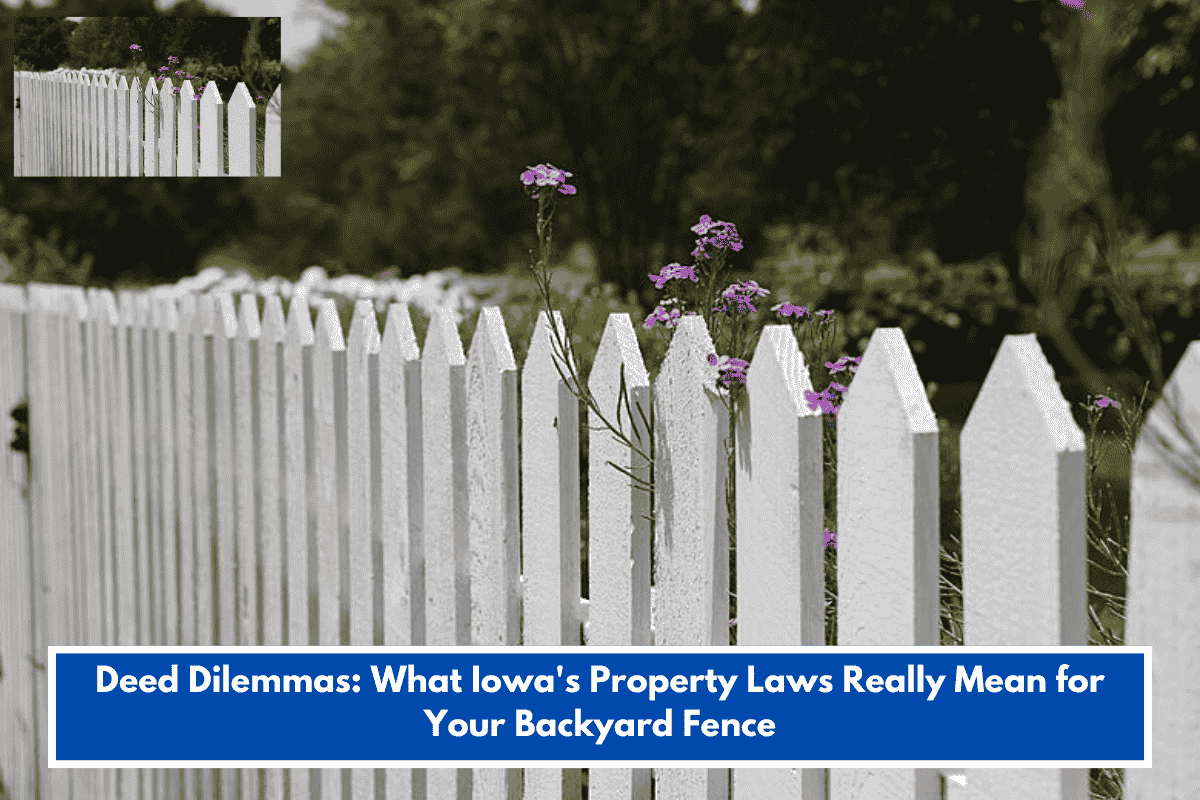
Iowa property deeds define your legal boundaries, but backyard fence issues often hinge on partition fence laws rather than just deed descriptions, especially for shared lines with neighbors.
Partition Fence Basics
Iowa has no general duty to fence your property unless a neighbor makes a written request under Iowa Code §359A.1A, triggering a shared obligation to build and maintain a “partition fence” on the boundary line between adjoining tracts.
This applies to both rural agricultural land and urban lots within cities; the fence must meet state specs for a “lawful fence” (e.g., at least 4 feet high for livestock, properly braced posts).
No fence is required without that request, and there’s no common law mandate to erect one proactively.
Who Pays and Builds
Responsibilities are typically split equally, but you can agree otherwise in a written, recorded agreement filed with the county recorder, which binds heirs and future owners.
If no agreement, either owner requests “fence viewers” (township trustees), who inspect, decide portions (often using the informal “right hand rule” from the center outward), and issue a binding written order recorded with the county.
One owner can make their section a “tight fence” (posts ≤20 feet apart, securely fastened), forcing the neighbor to match it.
Disputes and Enforcement
Fence viewers resolve fights; their order is enforceable in district court, with appeals possible within 20 days.
If a fence is at a slightly off-boundary spot but both sides have acquiesced to it for 10+ years (treating it as the line), Iowa Code ch. 650 can legally establish it as the true boundary, overriding the deed.
Hedges as fences require trimming twice yearly (June and September) to 5 feet high unless agreed otherwise in a recorded writing.
Deed vs. Fence Reality
Your deed (recorded at the county recorder) sets the exact metes-and-bounds or lot lines, but fences don’t automatically prove ownership—surveys do for disputes.
Encroaching fences (e.g., over the line) can lead to adverse possession claims if unchallenged for 10 years, but partition laws prioritize neighbor agreements over fights.
Check your deed and survey before building; if a neighbor disputes, start with a written request to township trustees to avoid court.
For your specific backyard, review the deed at your county recorder’s office and consider a survey if lines are unclear. If it’s a shared fence dispute, document the neighbor request in writing first.