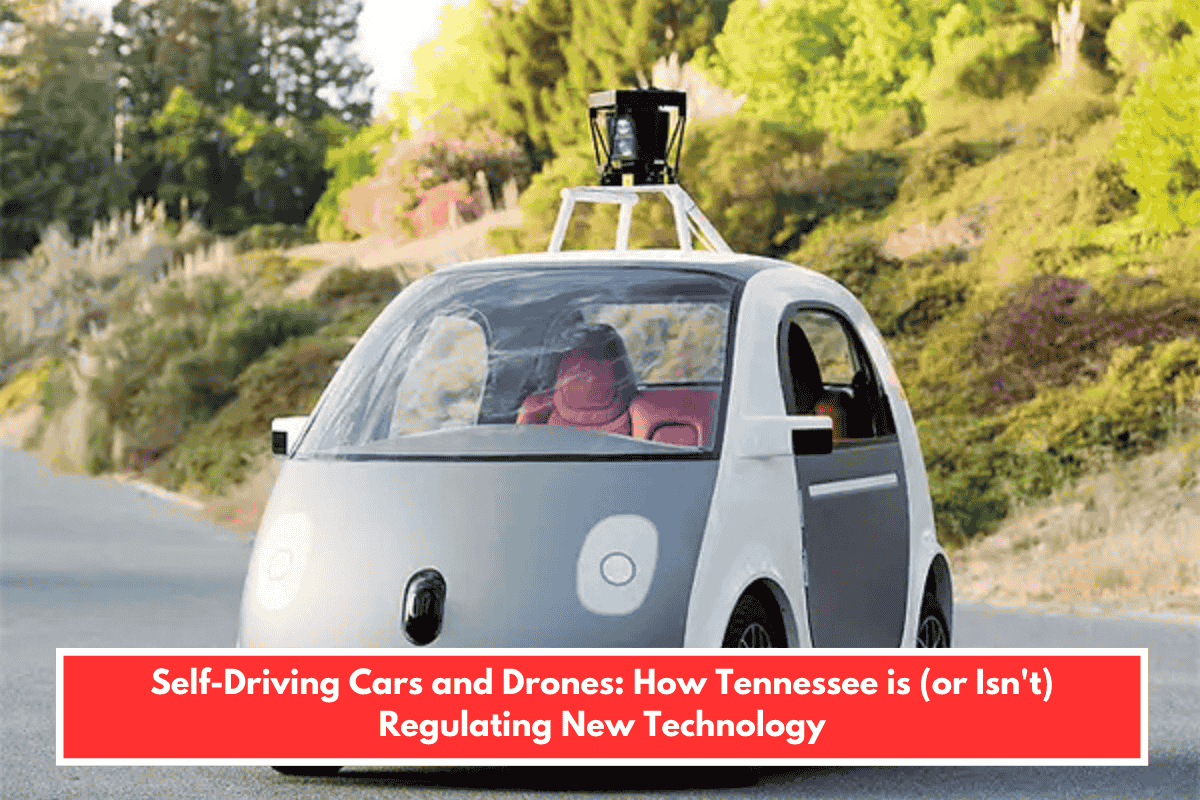
Tennessee permits operation of autonomous vehicles without a human driver under specific conditions, emphasizing minimal regulation to foster innovation. Drones face stricter rules focused on registration, airspace limits, and privacy, with no comprehensive overhaul in 2026.
Autonomous Vehicles
State law (Tenn. Code Ann. § 55-30-101 et seq.) allows ADS-operated vehicles up to Level 5 to run driverless if manufacturer-certified for federal safety standards, capable of minimal risk in failures, and properly registered. Local governments cannot ban them, per § 55-8-202, but commercial transport proposals like SB0310 and HB1168 stalled in 2025 committees. Vehicles must meet all conventional traffic and financial responsibility rules.
Drone Regulations
Tennessee aligns with federal FAA mandates requiring registration for drones over 0.55 pounds, remote ID broadcasting, and visual line-of-sight operations. State additions ban drone flights over critical infrastructure like prisons or power plants without permits (Tenn. Code Ann. § 39-13-609), with privacy protections against surveillance on private property. No major 2026 updates expand on recreational or commercial use beyond FAA Part 107 certification.
Regulatory Gaps
Tennessee’s hands-off AV stance contrasts with drone curbs prioritizing public safety, leaving liability and cybersecurity to evolving case law. Pending bills signal potential tightening for hired transport, but deployment remains open as of January 2026.