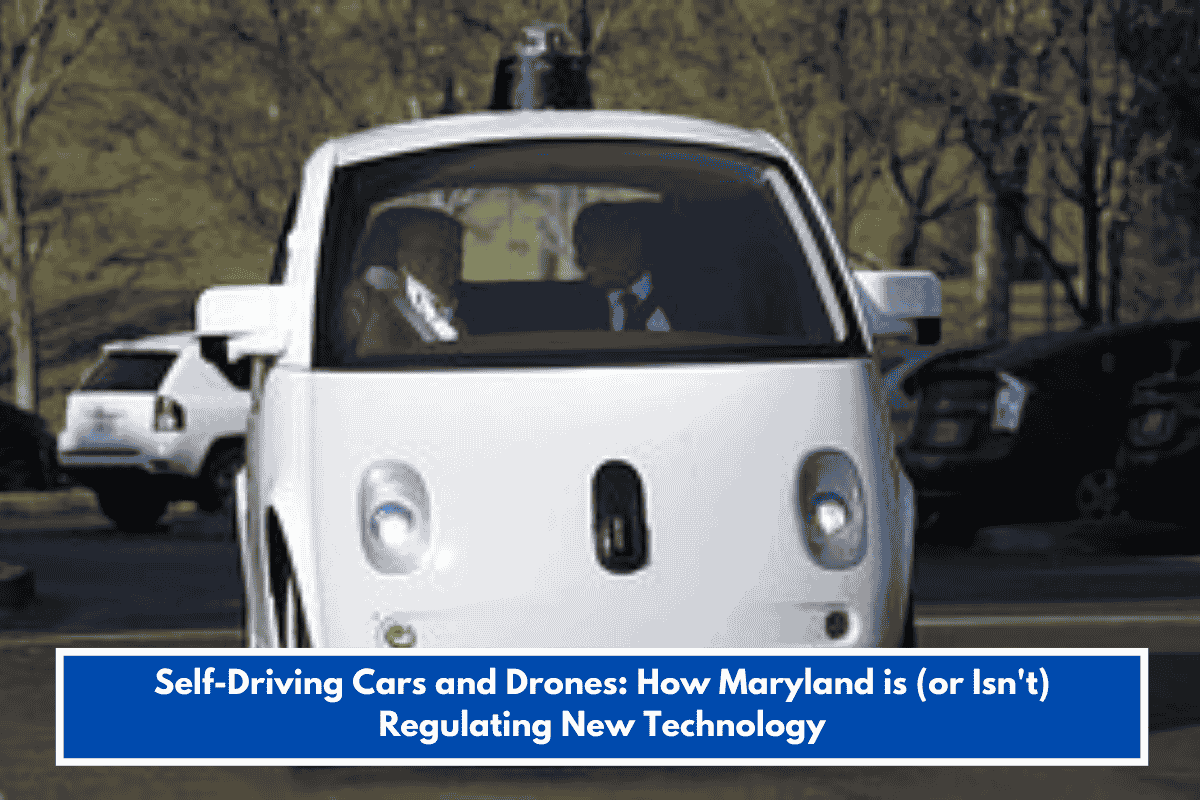
Maryland has taken a cautious and patchwork approach to regulating self-driving cars and drones, with limited comprehensive laws in place as of early 2026. While testing permits exist through the Maryland Department of Transportation, broader deployment faces hurdles from proposed bills emphasizing safety and human oversight. Drone rules align more with federal FAA guidelines but include state-specific restrictions on operations.
Self-Driving Cars
Maryland lacks overarching legislation for fully autonomous vehicles (AVs), though the MDOT issues permits for testing on designated sites like parking lots and test tracks. Bills such as HB439 (introduced January 2025) mandate human operators for vehicles over 10,000 pounds and require incident reporting by manufacturers. SB949 (2025 session) proposes standards for fully autonomous operation on highways, including law enforcement interaction plans submitted to the MVA, but its passage remains pending.
Past efforts like HB2013 and SB902 (2017) failed, leaving no statewide framework for public road deployment without human drivers. Advocacy from groups like the National Federation of the Blind pushes for AV access to benefit disabled residents, noting 25 other states allow testing or operations. Safety incidents nationally, including Cruise and Tesla probes, fuel Maryland’s conservative stance.
Drone Regulations
Drones fall primarily under federal FAA oversight in Maryland, requiring registration for devices over 0.55 pounds and restricting flights near airports or over crowds. State laws prohibit drone use for hunting, surveillance without consent, or interfering with emergency responders, with fines up to $1,000 for violations. Local rules in areas like Baltimore add no-fly zones around critical infrastructure [ from prior context].
No major 2026 updates expand commercial drone delivery or BVLOS (beyond visual line of sight) operations statewide, though testing occurs via FAA waivers. Maryland’s approach prioritizes privacy and public safety over rapid tech adoption.
Gaps and Trends
Federal inaction leaves states like Maryland regulating piecemeal, creating inconsistencies for AV and drone firms. Economic concerns, such as job losses cited by Teamsters, slow progress on self-driving tech. Compared to leaders like Arizona or Florida, Maryland lags, focusing on controlled testing rather than full commercialization.