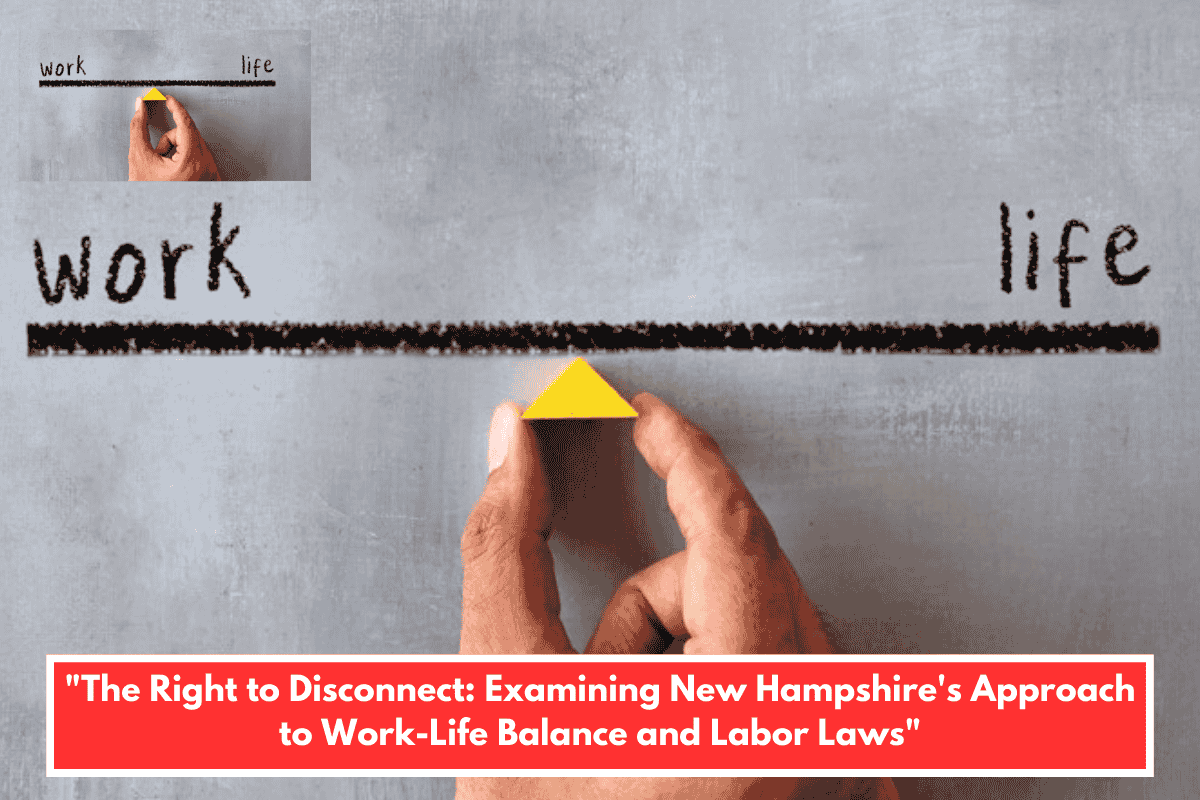
New Hampshire has no “right to disconnect” law protecting employees from after-hours work communications, unlike states such as New York or California that enacted such measures in 2025. The state’s labor laws under RSA 275 focus on wages, hours, and at-will employment without mandates for off-duty disconnection, leaving work-life balance to employer policies or private agreements.
Labor Laws Overview
New Hampshire follows at-will employment, allowing termination without cause except for protected reasons like discrimination under RSA 354-A. Overtime rules apply to non-exempt workers over 40 hours weekly at 1.5 times pay, but no provisions address electronic contact outside shifts. Recent 2025 laws emphasize privacy (effective Jan 1), guns, and voting but omit right-to-disconnect reforms.
Work-Life Balance Approach
Employers may implement voluntary “right to disconnect” policies to boost retention, but no statutory penalties exist for violations. The state promotes balance through flexible scheduling incentives rather than mandates, aligning with its limited-regulation business climate. Workers facing constant availability can negotiate boundaries or seek union protections where applicable.
Comparison to Other States
SOURCES
[1](https://www.law.cornell.edu/regulations/new-hampshire/N-H-Admin-Code-SS-Puc-1203.11)
[2](https://www.law.cornell.edu/regulations/new-hampshire/N-H-Admin-Code-SS-En-1204.03)
[3](https://www.seacoastonline.com/story/news/politics/state/2024/12/17/new-hampshire-new-laws-2025-guns-transgender-rights-voting/76886452007/)
[4](https://translegislation.com/bills/2025/NH)
[5](https://www.citizenscount.org/bills/hb-66-2025)