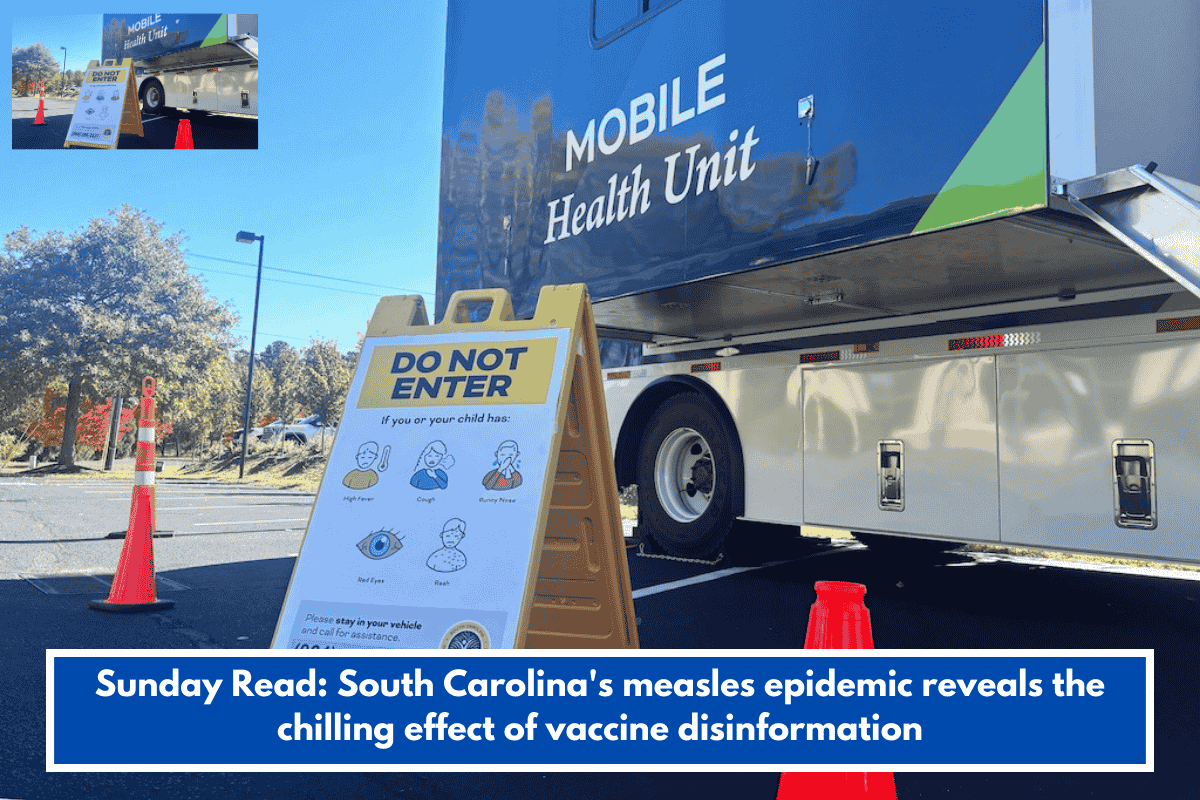
Boiling Springs, South Carolina — In early November, the South Carolina Department of Public Health set up a pop-up clinic near the back corner of the local library’s parking lot, mostly hidden from the main road, to provide free measles vaccines to adults and children.
Spartanburg County, in South Carolina’s Upstate region, has been combating a measles outbreak since early October, with more than 50 cases reported. Health officials have encouraged unvaccinated persons to be vaccinated by visiting one of the county’s mobile vaccine clinics.
But on a Monday afternoon in Boiling Springs, only one person arrived.
“This is development. “That progress is slow,” Linda Bell, the state epidemiologist of the Department of Public Health, stated at a recent press briefing. “We had hoped to see a more robust uptake than that in our mobile health units.”
As South Carolina works to manage its measles epidemic, public health authorities throughout the country are afraid that the extremely contagious virus is making a comeback. In 2025, the Centers for Disease Control and Prevention reported more than 1,700 measles cases and 45 outbreaks. The greatest outbreak began in Texas, infecting hundreds of individuals and killing two children.
For the first time in almost two decades, the United States is about to lose its measles eradication status, which indicates that outbreaks are infrequent and quickly managed.
South Carolina’s measles outbreak isn’t as widespread as those in other states like New Mexico, Arizona, and Kansas. However, it demonstrates how a confluence of larger national trends — including historically low vaccination rates, skepticism fueled by the pandemic, misinformation, and “health freedom” ideologies promulgated by conservative politicians — has put some communities at risk of the reemergence of a preventable, potentially deadly virus.
“Everyone talks about it being the canary in the coal mine because it’s the most contagious infectious disease out there,” said Josh Michaud, associate director of global and public health policy at KFF, a health information charity that publishes KFF Health News. “The logic is indisputable that we’re likely to see more outbreaks.”
Schools and’small brush fires’
Spartanburg has one of the lowest immunization rates among South Carolina’s 46 counties. That was true “even before covid,” according to Chris Lombardozzi, senior vice president of Spartanburg Regional Healthcare System.
According to state records, over 6,000 pupils in Spartanburg County schools last year — 10% of total enrollment — either acquired an exemption from mandated vaccines or did not meet vaccine standards.
Lombardozzi stated that the county’s low vaccination rate is due to disinformation pushed not only on social media but also by “a variety of nonmedical leaders over the years.”
The pandemic made matters worse. Michaud stated that fear and disinformation about covid vaccinations “fueled people’s vaccine skepticism.” In certain situations, distrust has spread to childhood immunizations, which have traditionally been less controversial, he added.
This put communities like Spartanburg County, which have low immunization rates, more vulnerable. “Which is why we’re seeing constant, small brush fires of measles outbreaks,” Michaud declared.
Between the 2020-21 and 2024-25 academic years, the overall percentage of Spartanburg students who received needed vaccines decreased from 95.1% to 90%. According to public health professionals, at least 95% is required to prevent significant measles spread.
Children in South Carolina’s public and private schools must provide proof of immunization, including the measles, mumps, and rubella vaccine, but religious exemptions are very easy to get. The exemption form must be notarized, but it does not require a doctor’s letter or revelation of the family’s religious beliefs.
The number of kids in South Carolina who have received religious exemptions has risen considerably over the last decade. That is especially true in the Upstate region, where religious exemptions have surged sixfold since a decade ago. According to data published by The Post & Courier, 2,044 Upstate students received religious exemptions from immunization requirements during the 2013-14 school year. By fall 2024, that figure had risen to almost 13,000.
Certain schools are more exposed than others. According to data published by the Department of Public Health, the outbreak in South Carolina began primarily at one public charter school, Global Academy of South Carolina, where only 17% of the 605 students enrolled during the 2024-25 school year provided documentation proving they had received their required vaccinations.
No one from Global Academy responded to our interview requests.
‘Health Freedom’
In April, after visiting a Texas family whose daughter had died of measles, Health and Human Services Secretary Robert F. Kennedy Jr. stated on social media that the “most effective way to prevent the spread of measles is the MMR vaccine.” He made a similar assertion during an appearance on “Dr. Phil” later that month.
However, these endorsements contradict Kennedy’s previous statements that questioned vaccine safety and incorrectly connected vaccines to autism. The CDC, which is under his jurisdiction, now alleges that such correlations “have been ignored by health authorities.”
“What would I do if I could go back in time and avoid giving my children the vaccines that I gave them?” he asked on a podcast in 2020. “I’d do anything for it. I’d give anything to be able to achieve it.”
Throughout 2025, he made additional inaccurate or unsubstantiated comments. During a congressional hearing in September, Kennedy maintained his previous comments that he was not anti-vaccine, but he reiterated his expressed opinion that no vaccine is safe or effective.
According to Emily Hilliard, a Department of Health and Human Services spokesperson, Kennedy is “pro-safety, pro-transparency, and pro-accountability.” Hilliard stated that HHS is collaborating with “state and local partners in South Carolina” and in other states to give assistance during the measles outbreaks.
Meanwhile, Kennedy has regularly advocated for health freedom, or vaccination choice, which has become a popular talking point among Republicans.
That has had a “chilling effect all the way down through state and local lawmakers,” Michaud said, making some officials hesitant to discuss the ongoing measles outbreaks or the MMR vaccine’s efficacy and safety.
Brandon Charochak, a spokesperson for South Carolina Gov. Henry McMaster, stated that the governor was unavailable for an interview for this piece, but cited McMaster’s October statement that measles “is a dangerous disease, but in terms of diseases, it’s not one that we should panic about.”
On a different occasion that month, the Republican governor stated that he does not support vaccine requirements. “We’re not going to have mandates,” said the politician, “and I think we are responding properly.”
Even though the South Carolina Department of Public Health has regularly advocated for measles immunizations, the endeavor has been noticeably quieter than the agency’s covid vaccine outreach initiatives.
In 2021, for example, the agency collaborated with breweries around the state on a program called “Shot and a Chaser,” which offered those who received a covid vaccination a free beer or soda. In contrast, the pop-up measles vaccine clinic inside the Boiling Springs Library had no bright marketing, no freebies, and was not visible from the main entrance.
Edward Simmer, the temporary head of the Department of Public Health, declined to speak with KFF Health News about the measles outbreak. Republican state legislators voted against his permanent confirmation in April due to his previous support for covid vaccinations and masking. During the hearing, one lawmaker specifically blasted the agency for the Shot and a Chaser campaign.
Other states’ public health authorities have also been barred from taking on new responsibilities as a result of their covid response. In Missouri, where MMR immunization rates among kindergarteners have fallen since 2020 and measles cases have been reported this year, Republican lawmakers rejected a public health director in 2022 after vaccine opponents protested his appointment.
In South Carolina, Simmer is the interim leader of the public health agency due to a lack of legislative confirmation.
South Carolina Senator Tom Davis of Beaufort was the sole Republican on the Senate Medical Affairs Committee who voted to confirm Simmer in April. He told KFF Health News that his Republican colleagues had voiced legitimate concerns about Simmer’s previous support for covid vaccinations.
However, Davis stated that it would be “tremendously unfortunate and not beneficial from a public health perspective” if the Republican Party just opposed vaccines “as a matter of policy.”
Between October and mid-November, the Department of Public Health gave 44 doses of the MMR vaccine via its mobile health unit. The last mobile vaccination clinic was scheduled for November 24. But health experts are happy that patients are looking for immunizations elsewhere. According to the agency’s tracking system, providers in Spartanburg County gave out more than twice as many measles vaccines in October than they did the previous year.
As of mid-November, over 130 persons remained in quarantine, the majority of whom were pupils at local elementary and intermediate schools. Cases have also been connected to a church and the Greenville-Spartanburg International Airport.
“We’re reminding people that traveling for the upcoming holidays increases the risk of exposure significantly,” said Bell, the state epidemiologist. “Due to that risk, we’re encouraging people to consider getting vaccinated now.”